
The Problem With Ambition, According to Amil Niazi
The Toronto journalist’s new memoir explores the cultural scripts around work, desire and the pressure to constantly want more.

Amil Niazi. Photo: Norman Wong.
For much of her life, Amil Niazi believed ambition would save her.
In the opening pages of her new memoir Life After Ambition, the Toronto-based journalist writes that being ambitious was her “only chance to escape the poverty and trauma” that had shaped her childhood. Told through a series of witty essays, the book moves through Niazi’s early life as an angsty teen, her trials and tribulations with finding (and keeping) a job in media, and her reflections on balancing work and motherhood.
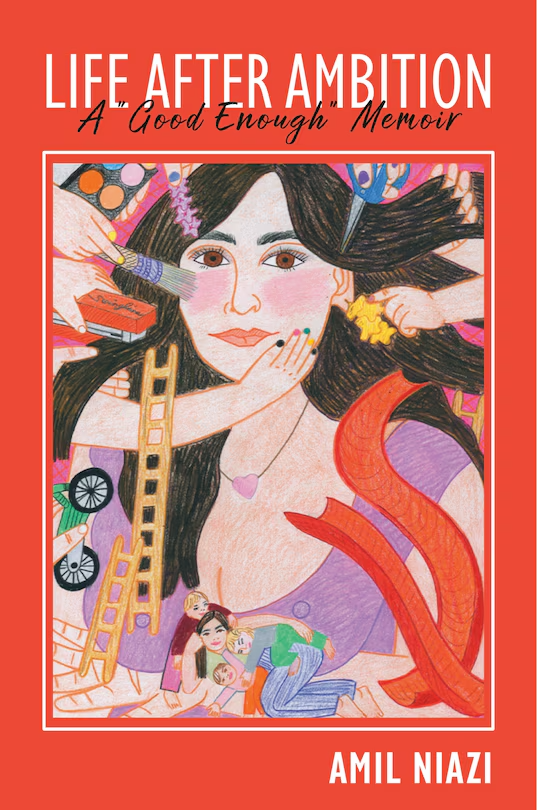
Ambition is an amorphous character in these essays, both fuelling and tormenting the narrator. Early on, Niazi tells of her time as a teenager when her parents would send her to the grocery store with a bank card and a list. After carefully picking out the items, she would punch in the PIN number and pray that a charge as little as $15 would go through. It often didn’t. Red in the face, she’d have to return everything to the shelves. Later, she began writing letters to her future self as a way of imagining a way out of her chaotic circumstances. “You have a great job writing for a magazine,” she wrote in one. In another, she wrote, “You live ALONE…you got out of here.” She kept these letters private, knowing she did not have the guidance or finances to actually achieve her lofty dreams. My inner child cried reading this section.
“I desperately wanted a creative writing career,” Niazi shares in an interview. But she knew that her parents did not have the means to support her; there is, after all, a reason South Asian immigrants emphasize the holy trinity of careers that is doctor, lawyer or engineer. These professions promise stability, financial security and the kind of respectability that can justify the sacrifices migration demands.
Still, Niazi charged ahead and went to journalism school. She says that at the time, the field “felt like a way to be writing-adjacent, while still working towards something that would bring me stable and reliable work.” Looking back, she laughs. For many years in her early career, she worked unpaid at an alt-weekly in Vancouver. Then, when she got a permanent, full-time role in Toronto, there was constant talk of layoffs at the company. Even at 35, mid-career, she was only making about $50,000 USD. “If this was as good as it was going to get, then I’m f–ked,” she writes in her book.
Fast-forward to today. Even through the industry’s ups and downs, she now boasts a resume that includes work at the CBC, Vice, BBC, and The Guardian.
Despite her clear success, a running question throughout Niazi’s memoir is: at what cost does this achievement come? She reflects on a time earlier in her career. She had just started a new role and moved to a new city when an attempt to break up with a partner ended in a painful assault. And instead of taking the time to heal, she went right into work, even while her home haunted her with flashbacks of the violence. Slowly, as the trauma seeped into her ability to show up to work, she began taking unprescribed pills. In the book, they are described as “blue and small,” helping her relax while offering escape and numbing the emotional heaviness she carried. Over the course of several months, she developed an addiction just to calm her nervous system enough to ensure she could show up bright-eyed and smiling. “I thought it made me a better employee, because it helped me to keep showing up when all I wanted to do was disappear and die,” she writes. She didn’t think she had another option, and ambition was supposed to be her escape.
It’s a familiar experience for many Asian immigrants to centre work as a means of getting ahead. In fact, a central belief upholding the model minority myth is that societal advancement comes by working hard without complaint, being agreeable and assimilating as best as possible. Niazi says she often had to “code-switch” at work: “I had to speak the right way, make sure none of my parents’ accents or euphemisms snuck into my speech. I had to downplay my identity, my religion and my culture in order to ‘fit in’ and be accepted in every single workplace.”
It eventually became clear to Niazi that her ambition could only take her so far. It was a survival tool, yes, but it no longer offered the reward it promised. “I still could not afford a house, I was saddled with debt, I often struggled to find work in my field or faced constant layoffs, I still hit a glass ceiling, where my white male peers succeeded despite their lack of experience or skills,” she says. While these peers moved into higher-profile hosting roles, secured speaking opportunities and built public visibility, these pathways seemed out of reach for her. Until, that is, she wrote this book.
“It’s no secret that marginalized people have to work harder than their non-marginalized peers to achieve the same or even lesser success.”
Later in the memoir, we see her grappling with the idea that perhaps it is possible — even necessary — to step away from relentless striving. The ambition that once propelled her forward had become exhausting, particularly as the demands of her job collided with motherhood. In 2019, she relocated to the U.K. for what she believed was her dream job as a commissioning editor. One day, seven months postpartum, she found herself answering emails while pumping breast milk in a secluded nursing room. Then, as a deadline loomed, she got up in a hurry, accidentally spilling the full bottle of milk. She nearly burst into tears.
Niazi eventually quit, despite the fancy title. In a later job, she refused to go into work while sick during the initial whispers of the COVID-19 pandemic, and held her ground when the absence was met with a passive aggressive response from her boss. Gradually, she returned to the writing she once loved but struggled to sustain, including artist profiles, pop culture criticism and personal essays. If her ambition was driven by fear before, it began to take a different form, fueled by creativity and autonomy.
It’s an alluring proposition to be more assertive and deliberate around goal-setting and work. But it also raised a difficult question for me, as Niazi’s reader. Even when the modern workplace is far from rewarding, can people of colour and immigrants really afford to take a step back — especially when our livelihoods, and sometimes even our visa statuses, depend on excelling within the very systems that exhaust us?
“If ambition was about survival for me, I’m now interested in seeing what desire looks like and where that takes me.”
Niazi acknowledged the tension, explaining, “It’s no secret that marginalized people have to work harder than their non-marginalized peers to achieve the same or even lesser success.” But reading her book, I’d draw a distinction between accepting those realities and internalizing them as a verdict on our worth. Piling self-punishment on top of it, the creeping fear that we're falling behind or that everything we've built could collapse, only compounds the damage. “Why should we deny ourselves the joy of being enough?” Niazi says. It’s not as direct an answer as I was hoping, but perhaps there isn’t a clear cut solution to the systems that demand we work to the bone while job security becomes increasingly precarious.
I don’t think Niazi negates these realities either when she suggests drawing clearer boundaries at work, or returning to pursuits that feel genuinely aligned with who you are. Importantly, her configuration of ambition is not about abandoning goals or disengaging from work entirely. It isn’t the internet’s version of resistance either where “quiet quitting” is a way of reclaiming agency by doing the bare minimum and emotionally checking out. Instead, she is proposing a different relationship to ambition altogether. The point is not to want less, or even to work less. It’s to stop orienting your life around the dread of being found inadequate or losing progress that no longer makes sense to you. She shares, “If ambition was about survival for me, I’m now interested in seeing what desire looks like and where that takes me.”
Life After Ambition is available now, wherever books are sold.