Why is Netflix’s ‘Best of the Best’ Pissing off so Many People?
Netflix’s new dance comedy is being both celebrated and dragged into a fight over representation. But maybe the problem is expecting one brown movie to represent all of us.
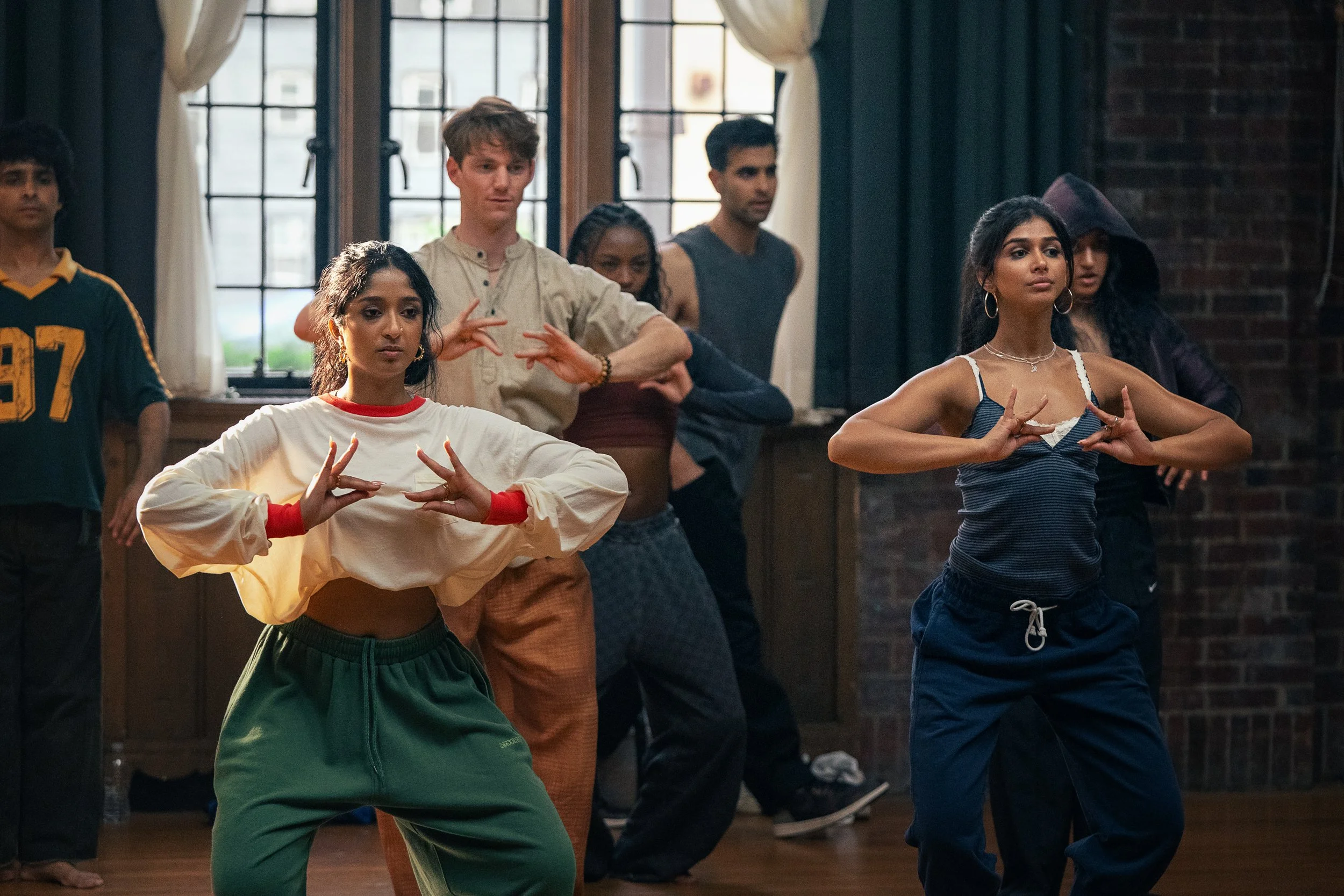
Maitreyi Ramakrishnan as Maya, Nico Greetham as Harry, Ankur Rathee as Ronak, Priyanka Kedia as Anjali, Amryn Khurana as Sumi in Best of the Best. (Photo: Emily V. Aragones/Netflix © 2026)
Netflix’s Best of the Best is a perfectly fine movie. And I don't mean that as an insult! It is a glossy, fun, predictable college dance comedy a la Step Up and Pitch Perfect in which hot people dance, kiss and fight, and an underdog team has to pull itself together before the big competition. Except, this time, the kids are brown, bringing to life the very real vibrance behind competitive dancing in the west. In that sense, it’s something new and overdue.
But in the few days since Best of the Best premiered, this otherwise fairly innocuous movie has inspired a complicated fight over South Asian representation. Some viewers have celebrated seeing the world of collegiate Bollywood-fusion dance onscreen, while others have criticized the film's portrayal of India and Indian culture. There’s been uglier commentary about star Maitreyi Ramakrishnan, and Afghan viewers have objected to an appalling joke that turns the chaotic 2021 evacuation of Kabul into a punchline.
All of which raises a question way more interesting than whether Best of the Best is any good: What exactly do we mean when we ask a movie to represent “South Asians”? Because there is a hell of a lot of us. (Like, literally over two billion, which is about a quarter of the global population.)
To answer this, first, let’s break down the movie itself. It follows Maya (Ramakrishnan) and Anjali (Priyanka Kedia), childhood best friends who, upon arriving at UCLA, join its competitive dance team. The film was directed by Lena Khan, and written by Hasan Minhaj and Prashanth Venkataramanujam, whose experiences with the collegiate Bollywood dance circuit inspired the story. This is a very important distinction to make, by the way: this is a movie about the South Asian American diaspora, not a movie about India. Still, so much of the discourse around Best of the Best seems to begin from the assumption that those are interchangeable things.
best of the best (2026) is highk my favorite representation of gen z south asian diaspora Of Late seriously such a fun way to show how we've found belonging within american college culture through a beloved cultural past-time
— nivs #assketballvictim (@rosegolisoda) September 19, 2026
I understand a bit of why. Part of what keeps this film from being even stronger is its massive effort to appeal to all and everyone that is brown. On the one hand, that’s admirable. We’ve all only begun to see accurate representation onscreen in recent years, and at a very slow pace and minimal dose. If one of us gets an opportunity to share a story, it seems only right to try to platform us all. On the other hand, that’s kinda impossible. In South Asia alone, there’s estimated to be over 4,500 distinct ethnic and cultural groups.
I myself am Pakistani Canadian. The largely Indian creative team behind this movie does not speak for me, nor do I expect them to. Similarly, a Tamil woman cannot truly stand in for a Punjabi or Nepali woman. None of us can or should contort ourselves into some universally recognizable version of brownness. All the same, am I thrilled to see a story like this make it to Netflix? Absolutely. Just seeing SASA (South Asian Students’ Association; iykyk), the stolen Koh-i-Noor and that one very Indian white guy who tends to hang around all get goofy shout-outs made my night.
“What exactly do we mean when we ask a movie to represent ‘South Asians’? Because there is a hell of a lot of us. ”
Which is what helped me realized that Best of the Best is most compelling when it gets specific. For example, throughout her career so far, Ramakrishnan has been careful to identify herself specifically as Eelam Tamil, with family “from Sri Lanka,” reflecting the indigenous history on the island and the refugee experience of fleeing the Sri Lankan civil war. Meanwhile, throughout the film’s series of fusion dance sequences, kuthu, a high-energy South Indian folk dance and music style originating from Tamil Nadu, gets its own already beloved moment.
Then there’s Ramakrishnan herself, a star through and through. What a joy to see a dark-skinned Tamil woman playing the lead in a glossy mainstream Netflix comedy, which should not feel particularly revolutionary in 2026 but here we are. Her character Maya can dance, she’s hilarious and biting, she does well in school and she’s a great friend.
cansada da netflix fingir que a maitreyi ramakrishnan não é uma das atrizes mais lindas dessa geração só para enfiar ela em papel de garota insegura. vocês realmente acham que eu vou acreditar que essa gostosa aqui é a “amiga feia”? para né pic.twitter.com/CitcmLCtlK
— lari jurídico trinity santos (@slipdaughter) September 21, 2026
In light of coordinated review-bombing of #bestofthebest, we encourage everyone who has watched the film to share their genuine thoughts on Rotten Tomatoes. If this film resonated with you, made you feel seen, or simply brought you joy, let your voice be part of its reception ♡ pic.twitter.com/LOI0hSmxFT
— Maitreyi Ramakrishnan Updates (@MaitreyiNews) September 21, 2026
Still, Best of the Best itself makes the strange decision to position her as the less desirable, allegedly unattractive friend. Yes, Kedia is beautiful. But, like, have we seen Maitreyi? Both girls are stunners and hold their own. Playing up the hot friend/dorky friend dynamic feels dated, and has spurred on vile backlash with many Indian fans striking out at the actress for being “too dark” or “dusky” and “ugly.” Evidently, they’re furious at Hollywood for its “continuous” casting of Sri Lankan actors in lead roles, but I find it hard to name many.
There is something wildly comical about Indian viewers objecting to the appearance of a dark-skinned South Asian woman in a movie celebrating South Asian culture when the region's biggest film industry has spent decades presenting a remarkably narrow vision of what a desirable South Asian woman looks like. Bollywood's beauty ideal has historically skewed light-skinned, going as far as hiring actual white women to play Indian, while darker-skinned South Indian and Sri Lankan actors have and still are often reduced to playing villains or the help. In 2026! Spurred by their baseless rage, these colourist basement-dwellers have taken to review-bombing the film as fast as their skinny fingers can type. Who really deserves a wake-up call here?
Colorism is a brain disease that prevents people from perceiving objective truths such as when women with dark skin are extremely hot https://t.co/1mw8OE98e7 pic.twitter.com/JZuT1YnTOW
— Moniza Hossain (@moniza_hossain) September 22, 2026
American vision of Indian beauty v continental Indian vision of Indian beauty pic.twitter.com/BSsVIo7Pjo
— if they go low, i go lowER (@Lunasreign_) September 21, 2026
Ultimately, this conversation points toward a larger tension between the diaspora and the subcontinent. Much of the criticism from India appears to judge Best of the Best against an idea of what Indian culture “actually” looks like. Yet the movie isn't especially interested in depicting contemporary India. And why should it be? This is the world of university dance competitions and kids who grew up in America consuming Bollywood alongside American pop culture. It’s a world in which Punjabi, Tamil, Gujarati, Hindi and other cultures can collide because children of immigrants encounter one another differently than their parents did back home.
Sure, Bollywood is a common cultural access point — not because it encompasses South Asia, but because, for many diaspora kids, it has historically been one of our most readily available connections to it. That alone is a point of tension — I personally used to be a big Bollywood fan, but then tired of its never-ending placement of Pakistanis as terrorists and extremists. (Yes. Still!)
“What a joy to see a dark-skinned Tamil woman playing the lead in a glossy mainstream Netflix comedy, which should not feel particularly revolutionary in 2026 but here we are.”
If anything, the diaspora's distance can make room for identities that the mainstream back home has marginalized. But, and this is a big ole but, Best of the Best also demonstrates how quickly that liberatory idea can fall apart when specificity is extended only to yourself.
Take, for instance, when, in an early scene, Maya tells Anjali, “Guys throw themselves at you like you're the last plane out of Kabul.” It’s meant to remind her that she’s hot and desirable. But it falls disastrously flat because, of course, it’s a reference to the tragic and desperate scramble many Afghans made while trying to board the last plane out of Kabul during the Taliban takeover in 2021. Many clung to the aircraft as it took off, falling to their death. The images are hard to forget, and what happened then in Afghanistan is still happening today. Which is why so many Afghan viewers eager to see brown representation with Best of the Best see it now as a reminder that they are not a welcome member of the Asian or “brown” community.
@lamewad_ I know that we have come to expect me to have something to say about everything and I know that I have a responsibility to. When I first saw people talking about this, there was a rage inside me that turned into a deep sadness that made it impossible to talk about. It was so beautiful to see the way that the rest of the Afghan community mobilized around this. - how loud you guys have been, how much pressure you're putting on these people, and how we're all coming together to let the world know that Afghan suffering is not the butt of your joke.@Hasan Minhaj @Netflix ♬ original sound - lamewad_
They're right to be angry. Again, it is particularly jarring in a movie whose greatest strength is its insistence that distinctions within South Asian identity matter. Ramakrishnan has made a point of calling herself Eelam Tamil, an identity shaped by its own history of persecution, displacement and war. She has actively resisted being absorbed into the easier, more marketable category of “Indian.” Best of the Best similarly gives Maya a specific identity rather than just making her generically brown; that’s entirely thanks to the actress.
So how does a movie that understands the importance of one community's history so casually turn another community's trauma into a joke? Maybe two men shouldn’t be writing for two women. But the answer also, perhaps, is that “South Asian solidarity” has always been more complicated than the entertainment industry's newfound enthusiasm for the term suggests.

Maitreyi Ramakrishnan as Maya in Best of the Best. (Photo: Emily V. Aragones/Netflix © 2026)
There is no single brown community. There are Indians, Pakistanis, Bangladeshis, Sri Lankans, Nepalis, Afghans, etc. There are countless ethnicities, languages and religions within those countries. There are also histories of partition, civil war, caste oppression, nationalism and ethnic violence between and within them. And then there are millions of us in the diaspora, building identities out of pieces inherited from our parents and borrowed from one another. Putting all of that under one cheerful “South Asian” umbrella may be politically and culturally useful, but it can also be an excuse not to look too closely at the differences underneath for the sake of a few one-liners.
And maybe that's the lesson buried beneath all the ridiculous discourse surrounding this very unserious dance movie: representation gets worse when we ask it to become broader, not better.