
India’s Gen Z Revolt Isn’t Over. Here’s How an Exam Scandal Sparked the ‘Cockroach’ Movement
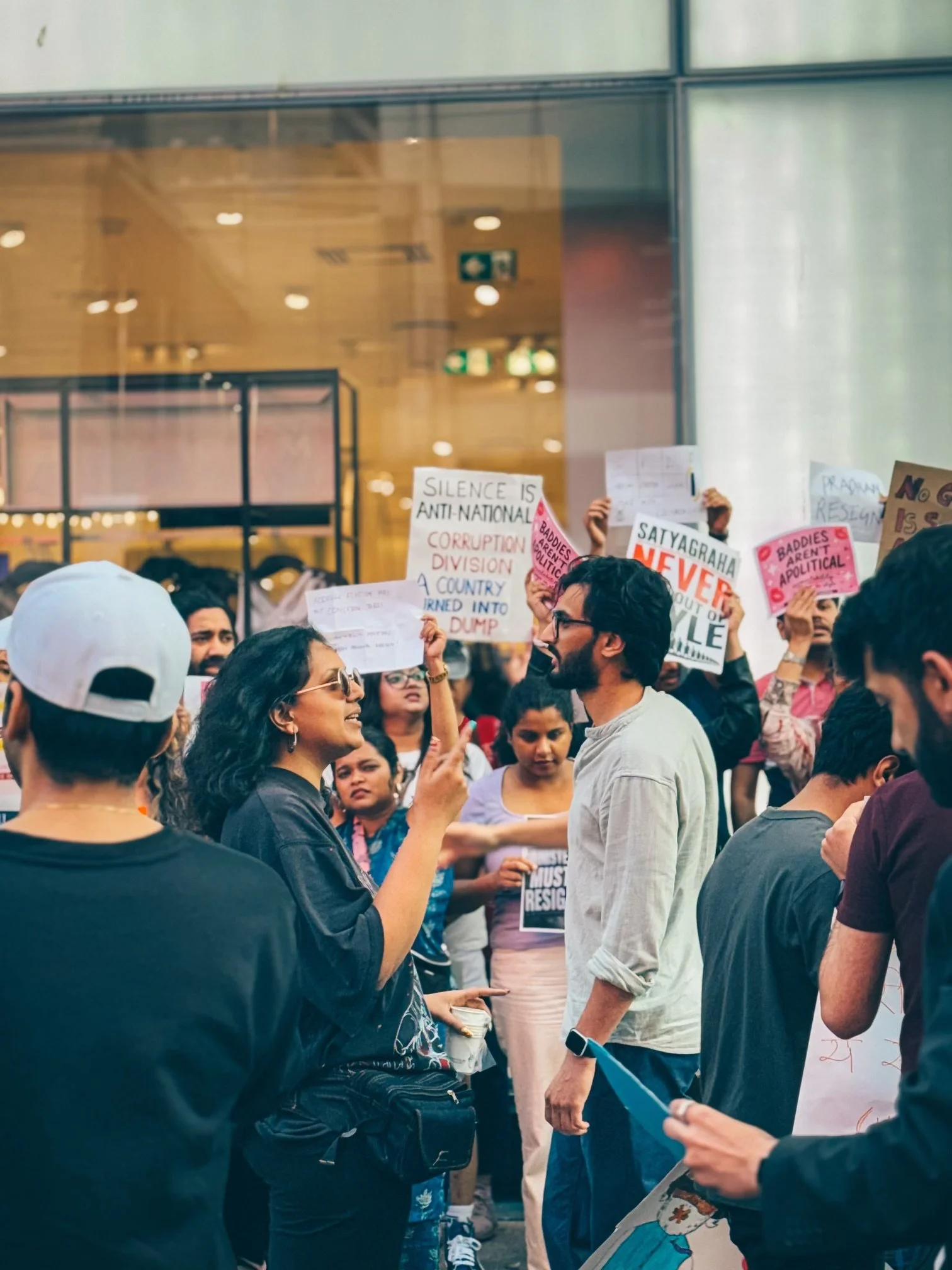
Gen Z protestors in Toronto. (Photo by: Hazeera)
The Cockroach Janta Party (CJP) was supposed to be back in the streets of New Delhi on September 5. Instead, days before thousands of young protesters were expected to march from India Gate to Delhi Police Headquarters, the group called the whole thing off — not because the anger that fuelled India’s explosive summer of student protests had faded, but because the government had finally taken notice.
The planned march had been called after organizers accused the Indian government of failing to deliver on promises that ended the CJP’s month-long sit-in on July 25. Among the outstanding demands were compensation for families of students who died by suicide amid the National Eligibility cum Entrance Test (NEET) scandal, the withdrawal of FIRs — formal police reports alleging serious crimes — against protesters, and protections from further legal action. But on September 1, the Supreme Court elected to quash FIRs registered against students who took part in the protests, while the government committed to compensating affected families. The CJP quickly declared victory. “Our demands have been heard,” the group said, while founder Abhijeet Dipke described the outcome as “absolute justice.”
It was a remarkable turnaround for a movement that, only weeks earlier, had been met with batons, tear gas and police crackdowns. And it suggests the thousands of young Indians who poured into the streets this summer may have accomplished something more consequential than a viral protest moment: they forced the government to respond. The unrest has hardly been confined to Delhi, either. Throughout August, thousands of young people marched in Jharkhand over alleged corruption and irregularities in government recruitment exams, where protesters were again met with tear gas, water cannons and batons. Together, the demonstrations point to a generation increasingly willing to turn its frustration with India’s education and employment systems into political pressure.
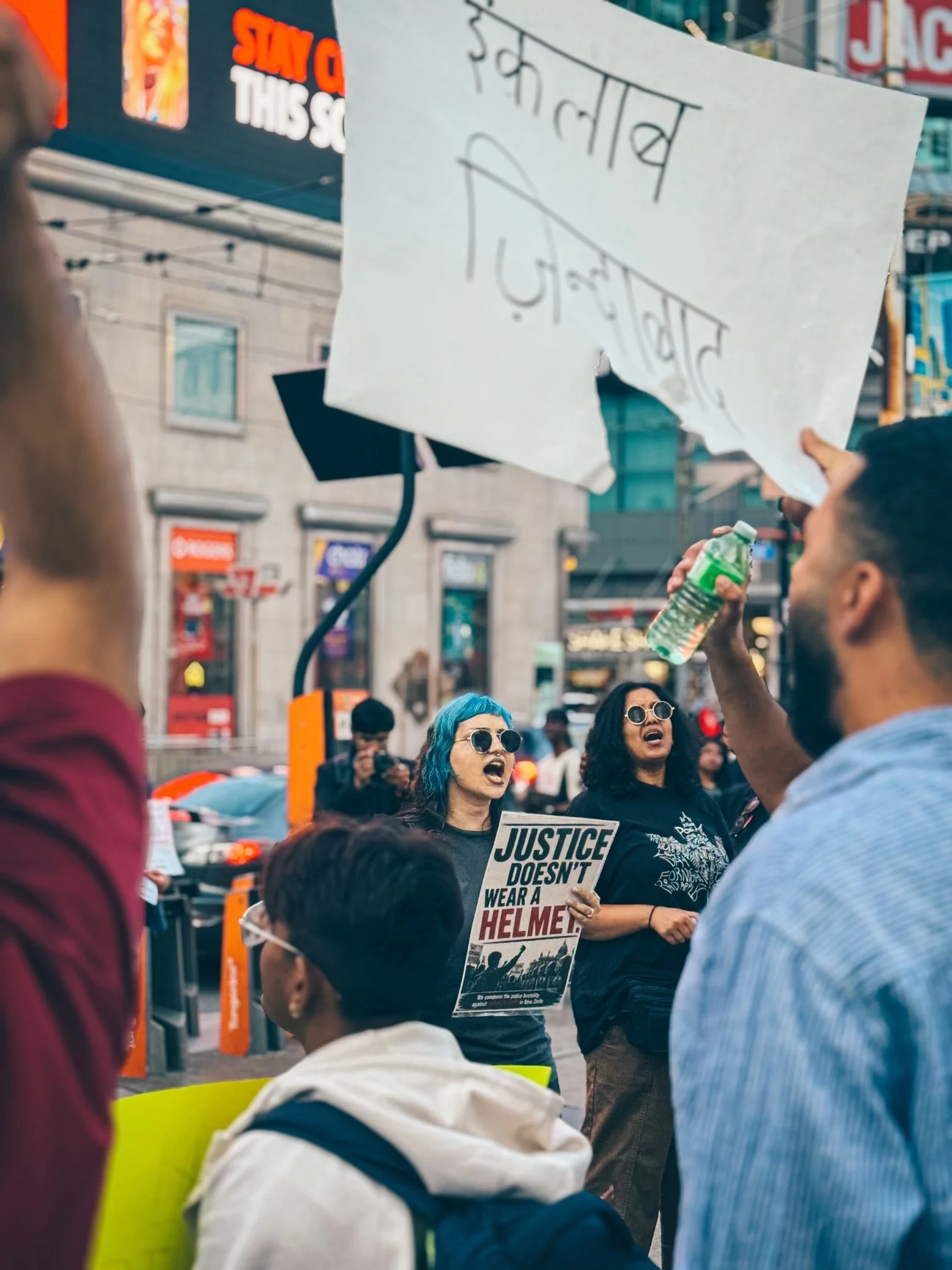
Scenes from a downtown Toronto protest in July, which saw a turnout of up to 500 people from the local community. (Photo by: Hazeera)
The countless images coming out of the student protests and that ricocheted across social media over the last few months said it all. Most notable was a shot of a young woman, later identified as model Rhiya Ahir, standing in a gray hoodie, soaked in the rain, her arm outstretched while blocking a police van. We also saw Gen-Z wit at its best with placards reading “even my pad has better leak protection,” “IKEA has better cabinets,” and “it’s giving small dick-tator energy” superimposed over Indian Prime Minister Narendra Modi’s face. What began as outrage over corruption in the education system evolved into one of the country's largest youth-led movements in years.
It all started in May, when India’s Supreme Court Chief Justice Surya Kant referred to a group of activists and unemployed youth as “cockroaches.” (Two weeks prior, he claimed his words were “misquoted and misused” in order “to mislead the youth.”) The chief justice’s remarks particularly struck a nerve because frustration had already been mounting among young people following irregularities in the NEET, India’s highly competitive entrance exam for medical and dental schools. Taken by millions of students each year, the exam was cancelled in May after allegations that the paper had been leaked to the highest bidder. Many families spend years and, in some cases, sell land to finance their children’s education and exam fees. In the aftermath of the leak, at least 12 students died by suicide, with some outlets reporting the number as high as 21 amid mounting distress over an education system many young people felt was failing them. The scandal, coupled with widespread youth unemployment, was the last straw.
In response, Abhijeet Dipke, a public relations graduate student at Boston University, tweeted, “What if all cockroaches come together?” From there, an online campaign dubbed the “Cockroach Janta Party” (CJP) was born in hopes of representing “the voice of the lazy and unemployed.” Yes, membership requires being both. With Dipke at the helm, alongside spokespersons and co-convenors Ashutosh Ranka and Saurav Das, the CJP grew from an online joke into an organized youth movement focused on unemployment, education and government accountability. The Cockroaches' first action: a petition calling for the resignation of education minister Dharmendra Pradhan. It garnered more than 800,000 signatures by late May.
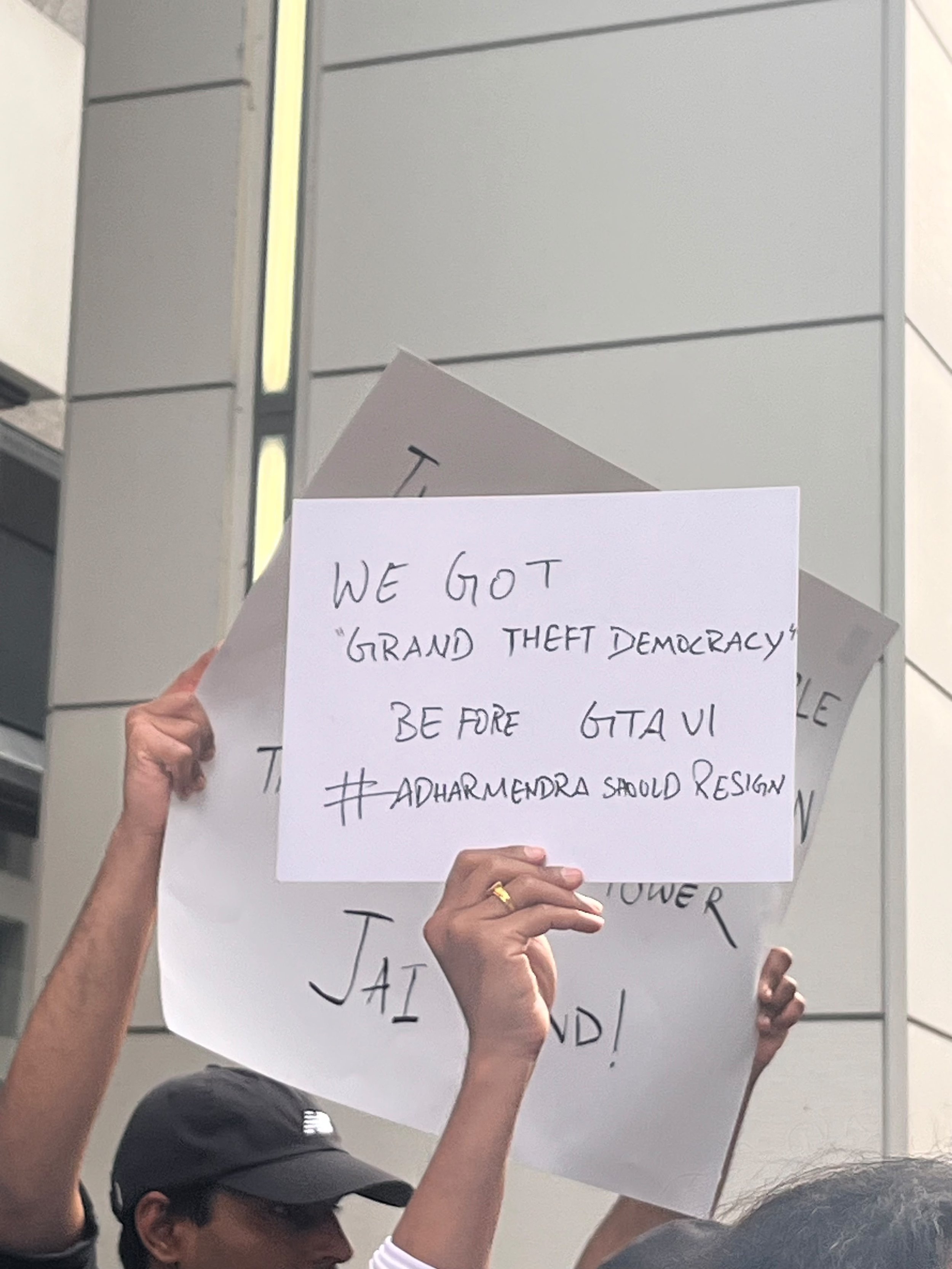
A person holds up a sign at a downtown Toronto protest in July, which saw a turnout of up to 500 people from the local community. (Photo by: Hazeera)
The CJP also exploded online, quickly surpassing social media followings of India’s established political parties. For reference, the ruling Bharatiya Janata Party’s (BJP) Instagram account has a following of 9.6 million; the opposition party, the India National Congress, has 14.9 million followers; and the Cockroach Janta Party now nearly doubles at 26.8 million followers.
In early June, Dipke returned from Boston and reportedly went straight from the airport to Jantar Mantar, a designated protest site in New Delhi, where he called on fellow “cockroaches” to join him. The movement gained further momentum after Indian education activist Sonam Wangchuk began an indefinite hunger strike in support. As concerns over Wangchuk’s health grew and he was eventually removed from the protest site by authorities, demonstrations spread across the country. By July 19, an estimated 25,000 people had gathered at Jantar Mantar to protest, with tens of thousands ready to march on parliament the following day.
Despite police denying permission for a major march, people continued to gather. Authorities shut down metro stations in an attempt to stop crowds from assembling. After, an hours-long internet shutdown, tear gas and baton charges also failed to disperse demonstrators. Instead, videos showing police violence, including women being beaten and protestors lying unconscious, circulated widely online, fueling greater public anger.
Watching from Toronto, public policy student Saarah (who asked that only her first name be used for fear of losing future professional opportunities) observed that, “Education in India, for a country with so much inequality holds so much promise. It can uplift you out of poverty, it can secure your future, it can earn you respect.” She has several family members living in Delhi, including her cousin and grandmother, who also attended the protest. Despite feeling helpless watching the brutality unfold from afar, she says she also felt immense pride for the courage many young people in India have displayed. “It’s easier for people to have a two-sides-of-the-coin approach when it comes to minorities or women’s rights, but not when it comes to education,” she says. “It’s your kids, it’s everyone.”
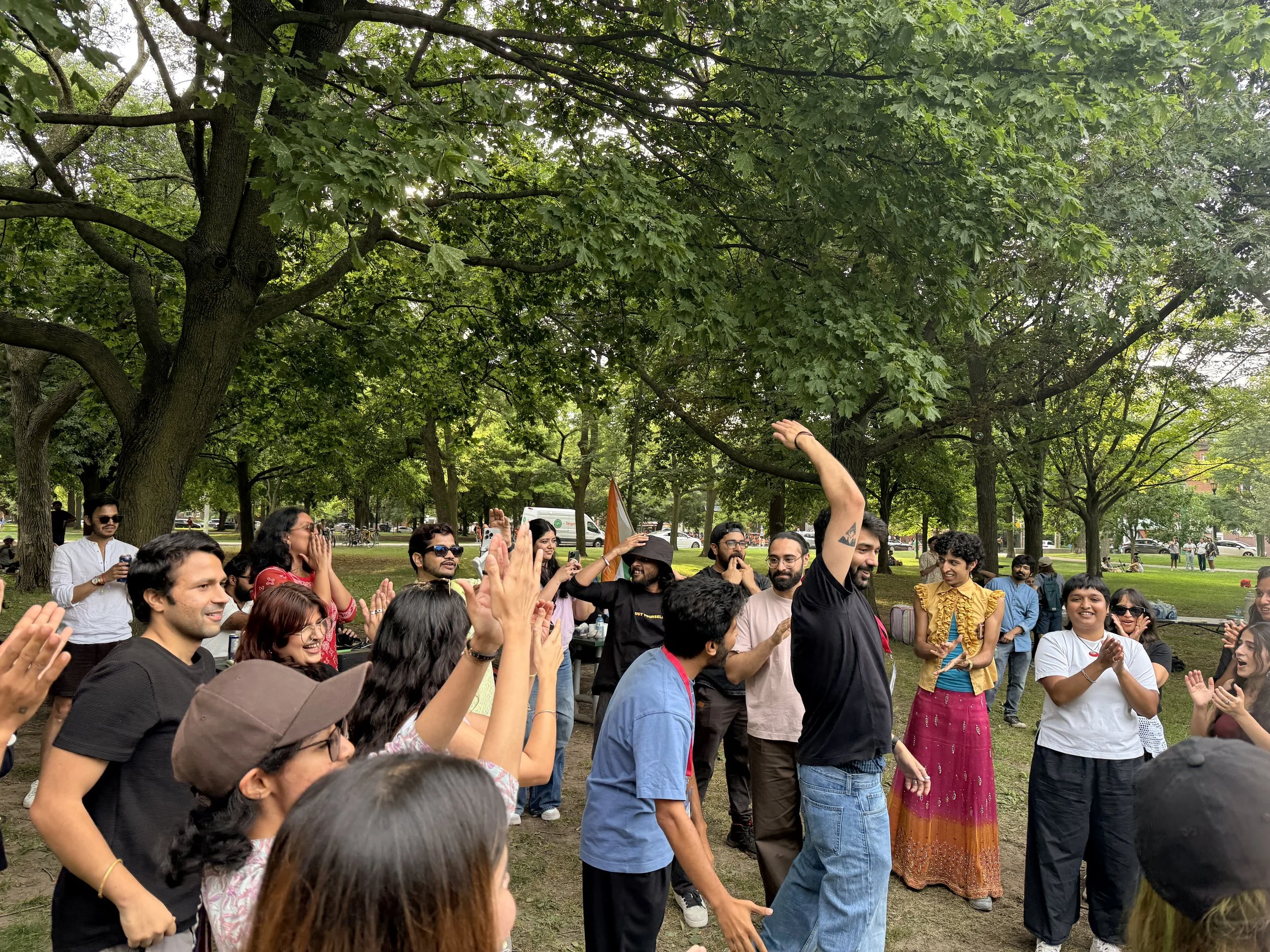
A gathering of Gen-Z Indians in Toronto. (Photo by: Chantelle Menezes)
As protestors began demonstrating for an even broader set of grievances, along with calls for Modi’s resignation, the CJP urged folks to stay focused on education so as to not dilute the movement’s original demands. Online and off, questions about how much control the CJP could still exercise over a movement that had grown beyond it arose.
While India has witnessed several major protest movements over the past decade, including the year-long farmers’ riots in 2020 and demonstrations against the Citizenship Amendment Act in 2019, this movement not only mobilized millions in the country, but also sparked a wave of solidarity among the Indian diaspora. In fact, Toronto’s response began almost as spontaneously as India’s.
“It’s easier for people to have a two-sides-of-the-coin approach when it comes to minorities or women’s rights, but not when it comes to education. It’s your kids, it’s everyone.”
A local group, Ontario Stands for Sir Sonam Wangchuk, started around July 20 as an Instagram page run by a handful of people. According to organizer Hazel Garg, also known by her artist name “Hazeera,” the people who initially started the page eventually stepped away, leaving her and other organizers to take over. While the Instagram page has since been deleted, the group’s WhatsApp chat has grown to more than 400 members.
The group initially organized demonstrations in front of the Consulate General of India on Bloor Street East. But after drawing local media coverage from Omni Television, they realized their movement could be big enough to potentially attract even more people. In the subsequent days, they moved to Sankofa Square to reach a larger cross-section of the South Asian diaspora. Hazeera, a 21-year-old University of Toronto graduate, used her network as an artist to help turn out nearly 400 to 500 people. Quickly, she became the “face” of the movement in Toronto.
She recalls leading chants for hours until she lost her voice. “We didn’t really know what to do at first. People just started coming and coming and coming,” she says. Many of the protestors who joined were Indian international students, who chose to pursue education abroad due to their frustration with the system back home. Some had taken the NEET previously and knew the pressures that came with the exam. The artist reports seeing older Indians protesting, too, quietly offering encouragement to their younger counterparts.
Around the same time protestors were gathering at Jantar Mantar and in Toronto, hundreds of international graduates in Calgary began demonstrating after their applications for post-graduate work permits were rejected. The protests, which began around July 17, eventually included a hunger strike. While Hazeera doesn’t know whether the demonstrations were directly inspired by those in India, the timing made her wonder whether the movement had offered others a model for making themselves heard. She says, “The facts might be wrong, but [what if] Jantar Mantar has reached them, and [reminded them], like ‘Oh, we can fight [back]?’”
As the Toronto demonstrations continued, some local organizers began asking what solidarity could look like beyond the streets. That question led Pratishtha Kohli, and other artists and organizers with the Tawoos Initiative, including Hazeera, to organize Sounds of Resistance, a fundraiser at Trinity Bellwoods Park. “We were seeing that in India, there were so many musicians and artists that were coming together, doing impromptu ciphers and showcases. They were using their platforms, and using their art because art is so intrinsically linked to protest,” says Kohli. “But we also wanted some concrete, actionable steps.”
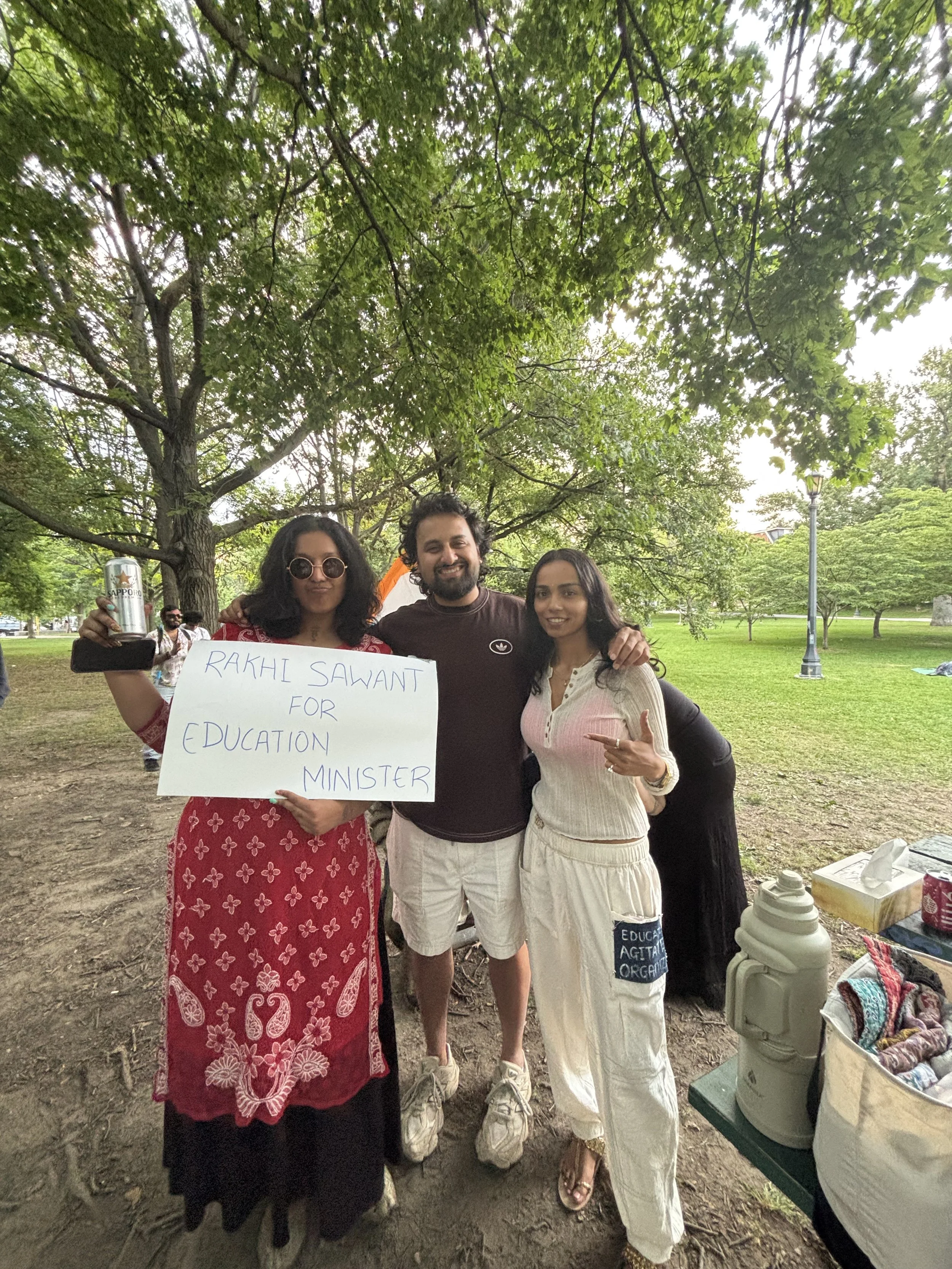
Supporters at Toronto’s Sounds of Resistance, a fundraiser for the cause at Trinity Bellwoods Park in July. (Photo by: Tawoos)
Planned in just 72 hours, the event came complete with a safety plan in case police or an opposition group showed up. But the afternoon went smoothly, and was repeatedly described by attendees as “incredibly wholesome.” Nearly 300 people gathered with picnic blankets, listening to live music and raising more than $3500 for organizations providing legal and medical aid to protestors on the ground in India.
By the time the Toronto event took place on July 25, India’s education minister, Dharmendra Pradhan, had already resigned. But the event went on as a show of unity and moral support from afar. For Kohli, one of the most meaningful parts of the afternoon was seeing a broad spectrum of the diaspora come together. Much like Saarah, it is not lost on Kohli that it is only because education is such a non-partisan issue that it was able to mobilize so many people back home. But Kohli marvelled at how, even in Toronto, people were able to come together despite their personal beliefs.
“The Indian diaspora is so fractured...it is historically known to be quite conservative,” she says. Yet the atmosphere in the park that afternoon was, she adds, “very liberating to be in.”
Still, Kohli points out that many Non-Resident Indians (NRIs) continue to support the BJP. A 2020 report by the Carnegie Endowment for International Peace found that among a nationally representative sample of 1200 Indian American respondents, about one-third favour the ruling BJP party, while two-fifths are generally apolitical with an arms-length relationship to Indian politics. While Modi’s approval was highest among respondents over the age of 50, he still had the support of about 35 per cent of those aged 18 to 29. Education did not necessarily diminish that support either, with Modi being more popular for those with a college degree than those without.
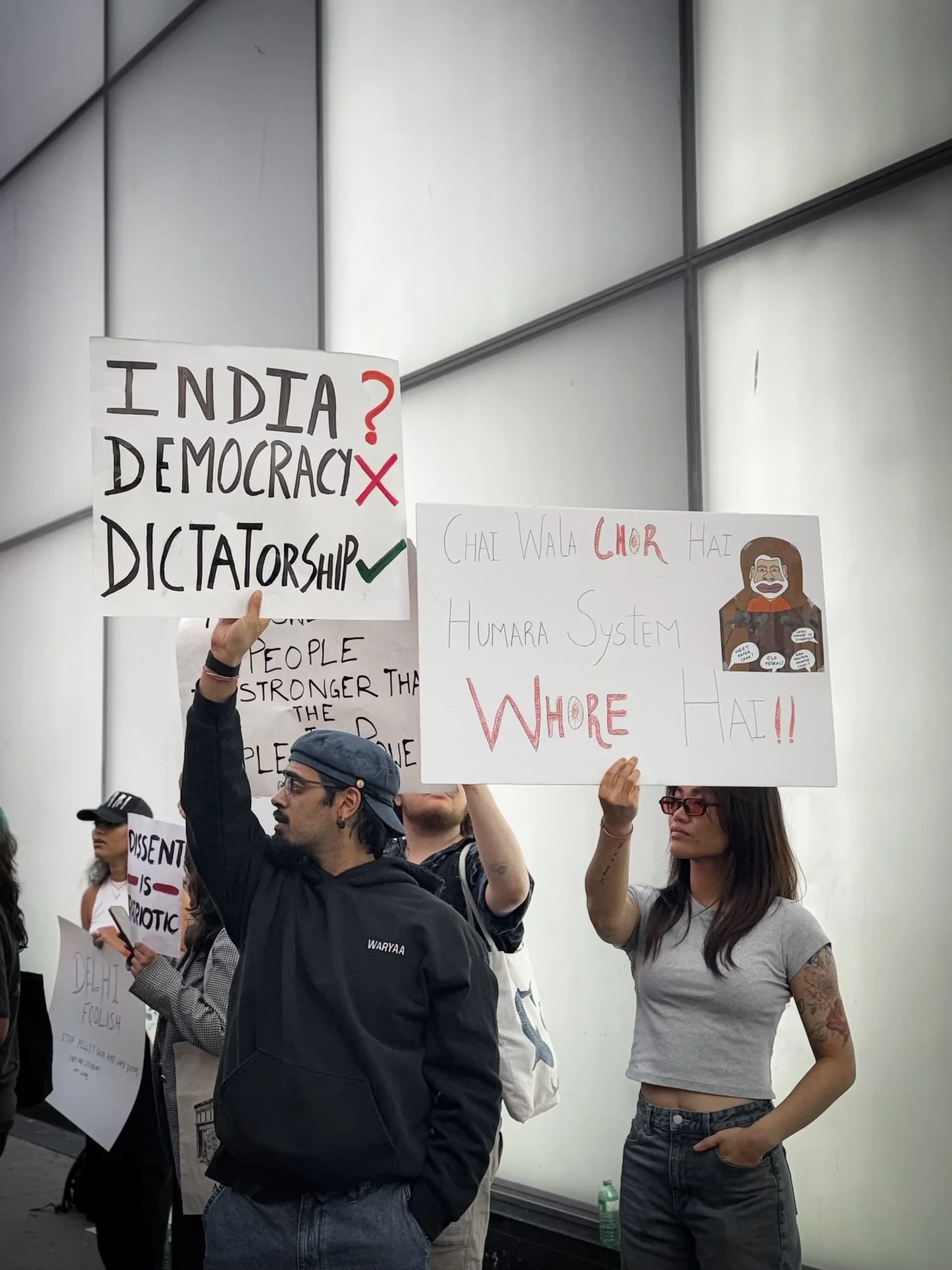
Individuals hold up signs at a downtown Toronto protest in July, which saw a turnout of up to 500 people from the local community. (Photo by: Hazeera)
The support across borders is key. A 2024 report in DW documented the BJP’s efforts to court support among the diaspora. In that article, Sanjay Ruparelia, a professor at the University of Toronto at the time, noted that members of the diaspora provide significant funding for parties and cultural organizations through donations, even if they themselves can't vote unless they are on Indian soil. The report also found that Indian citizens living abroad carry heavy influences over family back home, to the point of organizing community meetings and rallies, even prayers for a third Modi term.
Considering this political divide, it’s no wonder that Kohli was heartened by the turnout in Toronto. Still, she says there is much to do in the aftermath of the resignation. The new education minister, Pralhad Joshi, reportedly got his start in politics by volunteering with the right-wing Hindu nationalist organization Rashtriya Swayamsevak Sangh (RSS). He has also come under fire for defending the early release of rapists convicted in a case from 2002 where Bilkis Bano, a pregnant woman fleeing violence, was gang-raped.
For Hazeera, the appointment has complicated what might otherwise have felt like a victory. While she acknowledges that the resignation demonstrated the government listened to protestors, she wishes there had been more transparency and democracy around who would replace him. “Give us options of who you think is good enough to be the education minister,” she says. “Let’s hear about what they have to say about the country, and then let’s have an election; don’t do it overnight.”
In the aftermath of the protests, the government has attempted arresting protestors, taken down social media accounts criticizing Modi, and has been accused of using AI surveillance tools to collect data on protestors.
Here in Toronto, Hazeera is disappointed that the protests ended abruptly simply because the CJP in India called them off. However, she’s developed a community for herself and others through these solidarity demonstrations and hopes to continue advocating for better results in her home country.
“We built a little army of people that genuinely care,” she says. “We sat down and had a lot of political conversations. It’s insane to have found a group like this. I’d only ever heard about finding revolutionaries, finding inquilabis (revolutionaries) in your life. But now, I’ve genuinely experienced that myself.”